
Person County Genealogy Records
Person County was established in 1791 from Caswell County and named for Thomas Person, a prominent Revolutionary War patriot who served in the North Carolina General Assembly and was a strong advocate for the Bill of Rights. The county seat is Roxboro, located in the rolling Piedmont hills of north-central North Carolina near the Virginia border. Person County records begin in 1791, with marriage licenses, land deeds, court minutes, and probate files all dating from the year of formation. For genealogy researchers, Person County offers a well-documented history of agricultural families, tobacco growers, and textile workers who shaped this Piedmont community from the late 18th century through the modern era.
Person County Quick Facts
Person County Register of Deeds
The Person County Register of Deeds office in Roxboro maintains vital records and property documents from the county's founding in 1791. Marriage records begin that year, as do land deeds and court records. Birth and death certificates are available from 1913 onward. Wills recorded at this office cover the period from 1791 through 1968, after which probate matters were handled by the Clerk of Superior Court.
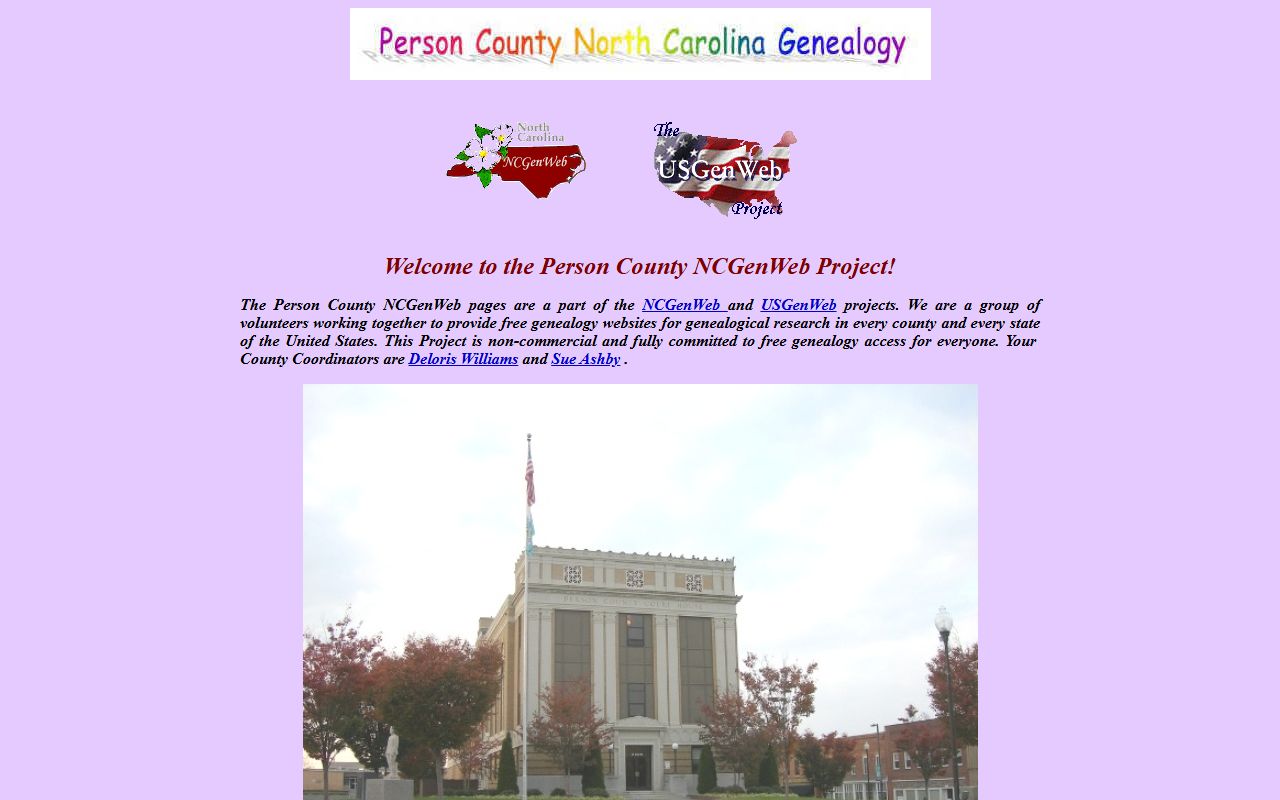
The courthouse stands on South Main Street in downtown Roxboro. Researchers visiting in person can access index books to locate specific records and request copies. The staff regularly assists genealogy visitors and can guide you through the available materials. It is advisable to call ahead to verify office hours and to prepare your search with names, approximate dates, and any known family details before arriving.
| Office |
Person County Register of Deeds 105 S Main Street Roxboro, NC 27573 Phone: (336) 597-7100 |
|---|---|
| Register | Phone: (336) 597-1724 |
| Hours | Monday through Friday, 8:30 AM to 5:00 PM |
| Website | personcounty.net/rod |
Early Settlement and Caswell County Origins
Before Person County existed as a separate jurisdiction, the land that would become Roxboro and its surrounding communities was part of Caswell County. Settlers moved into this area of the northern Piedmont throughout the mid-1700s, drawn by fertile soil and abundant water sources. Many of these early families came from Virginia and the eastern parts of North Carolina, following river valleys and trading paths into the interior.
When Person County was carved from Caswell in 1791, the new county inherited a population that was already well established. Families who had been recording their deeds, marriages, and court actions in Caswell County continued their lives under the new Person County government. Genealogy researchers must therefore consult Caswell County records for any Person County family before 1791. The Caswell County courthouse in Yanceyville holds those earlier records.
The formation of Person County also coincided with a period of westward migration. Some families who appear in early Person County records moved on to Tennessee, Kentucky, and points further west within a generation. Land sales in the deed books and disappearances from tax lists can signal these departures. Researchers who hit a dead end in Person County should consider checking records in frontier states where North Carolina migrants settled during the early 1800s.
Person County Marriage Records
Marriage records in Person County begin in 1791 with bonds that were required before a couple could legally wed. Each bond lists the groom, the bondsman, and the penalty amount. The bondsman was typically a close relative of the bride, often her father or brother. Identifying the bondsman can reveal family connections that are not documented anywhere else. Marriage bonds continued until approximately 1868, when the license system replaced them.
Marriage licenses from 1868 onward provide substantially more detail. They record the full names of both parties, ages, birthplaces, residences, occupations, and the names of both sets of parents. The minister or magistrate who performed the ceremony signed the return portion of the license. These returns confirm that the marriage actually took place and identify the officiant, which can help connect families to specific churches or communities within Person County.
African American marriage records from the Reconstruction period are available beginning in the late 1860s. These include both formal licenses and cohabitation records that legalized unions formed during slavery. The cohabitation records sometimes reference former owners or plantations, providing genealogical links that bridge the gap between antebellum and postwar documentation for African American families in Person County.
Person County Land and Property Records
Land deeds in Person County date from 1791 and chronicle every transfer of real property within the county. The rolling terrain of the northern Piedmont is described in these deeds through references to creeks, ridges, roads, and the properties of neighboring landowners. Early deeds also reference original land grants, some of which were issued by the state of North Carolina to Revolutionary War veterans as payment for their military service.
The tobacco economy shaped land ownership patterns in Person County for nearly two centuries. Small and mid-sized farms dominated the landscape, and deed books reflect the buying and selling of these agricultural parcels across generations. When a farmer died, his land was often divided among his sons, and the resulting deeds name each heir and describe their individual portion. These division deeds are excellent sources for identifying siblings and establishing birth order.
Tax records supplement the deed books by listing all property owners in the county along with the value of their holdings. Person County tax lists from the 1790s and 1800s survive at the North Carolina State Archives. They name heads of household and enumerate taxable property such as land acreage, enslaved people (before emancipation), horses, and cattle. Tax records are especially useful for tracking families between census years.
Person County Probate and Will Records
Wills in Person County span from 1791 to 1968. These documents name the testator's spouse, children, and often other relatives such as grandchildren, siblings, or in-laws. The distribution of property described in a will provides a clear picture of family structure at the time the will was written. Land, livestock, household items, farm equipment, and sometimes enslaved individuals (in wills predating emancipation) are enumerated and assigned to specific heirs.
Estate inventories accompany many probate files and list every item of value owned by the deceased at the time of death. These inventories describe tools, furniture, kitchen utensils, books, fabrics, and other possessions that illuminate how families lived. The total value of the estate was calculated and recorded, which helps researchers gauge the economic standing of their ancestors.
When someone died without a will, the court appointed an administrator to settle the estate. The administrator filed a bond, inventoried the property, paid debts, and distributed the remainder to legal heirs according to North Carolina statutes. The resulting court records name all heirs and describe the division of property. For researchers, intestate estate records can be even more informative than wills because they require the court to identify every living heir, including married daughters whose surnames had changed.
Agricultural and Textile Heritage
Person County's economy was built on tobacco farming and, later, textile manufacturing. These industries shaped the daily lives of county residents for generations and left traces throughout the public records. Census records list occupations such as farmer, tobacco curer, factory hand, and spinner. Tax records reflect the value of tobacco crops and manufacturing equipment. Court records include disputes over tobacco sales, labor agreements, and factory operations.
The Person County Museum of History in Roxboro preserves artifacts and documents related to these industries. Its collections include photographs of tobacco farms and textile mills, oral history recordings from workers and their families, and donated papers that supplement the official county records. The museum is a valuable resource for researchers seeking to understand the economic context in which their ancestors lived and worked.
Bright leaf tobacco, which became a signature crop of the Carolina Piedmont, was particularly important to Person County agriculture. The techniques for curing this type of tobacco were developed in nearby Caswell County in the 1830s and quickly spread to Person County. Farm journals, agricultural society records, and newspaper accounts from the 1800s and early 1900s describe the cultivation practices that defined rural life for most Person County families.
Researching Person County Families
Person County's position on the Virginia border means that many families had connections across the state line. Researchers should check Virginia county records, particularly those in Halifax County and Pittsylvania County, Virginia, for ancestors who migrated south into North Carolina. Cross-border marriages, land transactions, and church memberships were common, and the same families often appear in records on both sides of the line.
Federal census records for Person County begin with the 1800 enumeration, the first census taken after the county's formation. Every subsequent decade is available, and the census provides household composition, ages, occupations, and property values. The NCGenWeb Person County page offers free access to transcribed records, cemetery listings, and research guides compiled by volunteers.
Church records from Baptist, Methodist, and Presbyterian congregations in Person County are another important genealogy source. Membership rolls, baptismal registers, and burial records all name individuals and sometimes describe family relationships. Some of these records have been microfilmed or digitized and are available at the State Archives or through online databases. Vital records including birth and death certificates from 1913 forward can be ordered through North Carolina Vital Records.
Nearby Counties
Person County borders several other Piedmont counties in North Carolina as well as Halifax County, Virginia. Families routinely crossed these boundaries for trade, marriage, and land acquisition. Checking records in adjacent counties can reveal connections that are not visible in Person County records alone.