
Orange County Genealogy Records
Orange County occupies a central place in North Carolina history and genealogy. Formed in 1752 from Bladen and Johnston counties, it was named for William of Orange and originally encompassed a vast stretch of the Piedmont region. The county seat of Hillsborough served as a colonial capital and center of political activity throughout the eighteenth century. Records begin in 1752 with marriage bonds, land deeds, court minutes, and will books that survive in substantial numbers. Orange County's role in the Regulator movement and the Revolutionary War adds historical significance that makes its records particularly appealing to family historians.
Orange County Quick Facts
Orange County Register of Deeds in Hillsborough
The Orange County Register of Deeds at 228 S Churton Street in Hillsborough maintains the county's vital records and property documents. Marriage records date to 1752 and represent one of the most important collections for Piedmont genealogy research. Land deeds from the same year document property ownership across the fertile river valleys and rolling hills that drew settlers to this region. Birth and death certificates are available from 1913 forward. The office phone number is 919-245-2380.
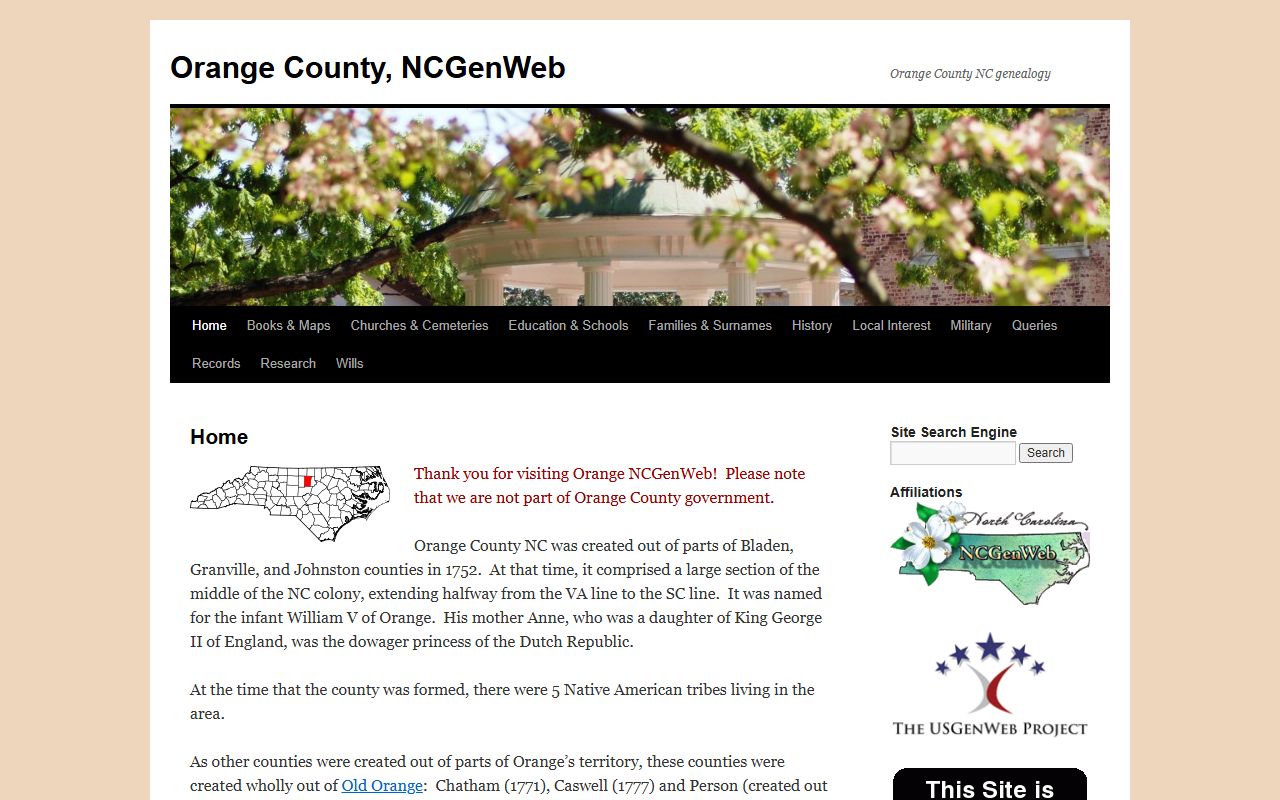
Researchers can access many Orange County records through the county website at orangecountync.gov/rod. The online system allows searching by name, date range, and document type. For older records that have not been digitized, an in-person visit to the Register of Deeds office in Hillsborough is necessary. The town itself is a rewarding place for genealogists to visit, as many historical structures from the colonial and federal periods still stand along its streets.
| Register of Deeds |
Orange County Register of Deeds 228 S Churton Street Hillsborough, NC 27278 Phone: (919) 245-2380 |
|---|---|
| Courthouse |
Orange County Courthouse 106 E Margaret Lane Hillsborough, NC 27278 Phone: (919) 245-2000 |
| Website | orangecountync.gov/rod |
Colonial Hillsborough and Revolutionary War Records
Hillsborough was one of the most important towns in colonial North Carolina, serving as the seat of the Hillsborough District and hosting sessions of the colonial assembly. The town's significance means that a wide range of records were created and preserved here, including not only county-level documents but also colonial administrative records that touch on families throughout the backcountry. Researchers tracing ancestors in Orange County should be aware that Hillsborough's records sometimes reference individuals from areas that later became separate counties, including Chatham, Caswell, Person, and Alamance.
The Regulator movement of the late 1760s and early 1770s had its epicenter in Orange County. Regulators protested corruption and excessive taxation by colonial officials, and their activities generated court records, petitions, and military documents that name participants and their families. The Battle of Alamance in 1771, which ended the Regulator uprising, involved many Orange County residents. Genealogists with Regulator ancestors can find relevant records in the colonial court minutes and in published compilations of Regulator documents at the North Carolina State Archives.
During the American Revolution, Hillsborough served as a meeting place for the Provincial Congress and later hosted the state convention that considered ratification of the U.S. Constitution. Orange County men served in Continental and militia units, and their service records, pension files, and bounty land applications are valuable genealogical sources available through the NCGenWeb Orange County page and the National Archives.
Marriage Records in Orange County
Orange County marriage bonds and licenses from 1752 onward provide essential data for connecting generations of Piedmont families. Early marriage bonds name the groom, the bride (or her father or guardian), and the bondsman, who was often a family member. These bonds served as a financial guarantee that there was no legal impediment to the marriage, and the relationships between the individuals named on the bond can yield important genealogical clues.
Marriage records from the nineteenth century and later include progressively more information. Licenses from the post-Civil War era typically list both parties' full names, ages, races, residences, birthplaces, occupations, and parents' names. This level of detail makes these records among the most comprehensive single documents available for genealogical purposes. Orange County marriage records can be obtained from the Register of Deeds in Hillsborough or through the North Carolina Vital Records office at vitalrecords.nc.gov for more recent records.
Land Deeds and Property Records in Orange County
The land records of Orange County begin in 1752 and reflect the rapid settlement of the Piedmont by families migrating south from Pennsylvania and Virginia along the Great Wagon Road, as well as families moving west from the coastal counties. Early land grants in this area were issued by the colonial government to encourage settlement, and the deed books record the subsequent sales, divisions, and gifts of these lands across generations of Orange County families.
Property descriptions in colonial Orange County deeds use the metes-and-bounds system, referencing natural features such as creeks, ridges, and marked trees. Adjacent landowner names appear frequently in these descriptions and can help identify family clusters and migration patterns. Gift deeds from parents to children are especially common in the Orange County deed books and provide direct evidence of family relationships. Researchers should also watch for trust deeds, mortgage documents, and powers of attorney in the deed books, as these sometimes contain family information.
Orange County Will Books and Estate Settlements
Will books from Orange County span the period 1752 through 1978 and are among the most frequently consulted records for Piedmont genealogy. The county's position as a major settlement area means that its will books contain a high volume of entries relative to many other North Carolina counties. A typical Orange County will names the testator's wife, children, and sometimes grandchildren, along with specific property bequests that can indicate the relative ages of children and the economic circumstances of the family.
Estate settlements in Orange County include not only wills but also intestate proceedings, where a person died without a will and the court appointed an administrator. These records are valuable because they name heirs and often include a division of property that lists each heir's share. Estate inventories, which catalog every item of personal property, can reveal an ancestor's trade or occupation. Sale records show who purchased items at estate auctions, and buyers were frequently relatives or neighbors. The combination of wills, inventories, and sale records can produce a remarkably detailed portrait of a family's life in Orange County.
Court Records and Civil Proceedings in Hillsborough
The Clerk of Superior Court at the Orange County Courthouse on 106 E Margaret Lane in Hillsborough maintains court records dating to 1752. These records encompass civil lawsuits, criminal cases, guardianship appointments, and bastardy bonds, all of which can contain genealogically significant information. Civil cases involving land disputes, debt collection, and inheritance conflicts often include depositions from witnesses who describe family relationships, property boundaries, and community events.
Guardianship records are particularly important for identifying orphaned children and the adults who assumed responsibility for their care. In Orange County, the court regularly appointed guardians for minor children whose fathers had died, and these appointments typically name the child, the guardian, and sometimes other family members. Bastardy bonds, while sensitive in nature, document the parentage of children born outside of marriage and can fill gaps in family lines that are otherwise difficult to trace.
Orange County Historical Museum and Research Collections
The Orange County Historical Museum in Hillsborough provides researchers with access to artifacts, documents, and exhibits that illuminate the county's rich past. The museum's collections include photographs, manuscripts, and material culture from the colonial period through the twentieth century. For genealogists, the museum offers context that helps interpret the records found in county offices, placing family events within the broader story of the community.
Researchers can visit the museum at orangehistorync.org for exhibit schedules and research inquiries. The museum also participates in preservation efforts for historic buildings and sites throughout Orange County, many of which are connected to families whose records appear in the county deed books and court files. Walking through Hillsborough's historic district, visitors can see structures built by the same families whose names appear in the eighteenth-century records at the courthouse nearby.
Birth and Death Certificates for Orange County
Birth and death records in Orange County begin in 1913 with the advent of statewide registration. These certificates can be obtained from the county Register of Deeds or from the North Carolina Vital Records office. Death certificates are especially valuable because they typically include the decedent's date and place of birth, parents' names, occupation, and residence, connecting the deceased person to earlier generations in the family tree.
For births and deaths before 1913, researchers must consult alternative sources. Presbyterian, Quaker, Lutheran, and Baptist church records from Orange County sometimes contain baptismal entries, burial records, and congregational rolls that serve as substitutes for civil vital records. Cemetery transcriptions from graveyards across the county provide dates and family relationships that supplement the documentary record. The NCGenWeb project and local historical societies have published many of these transcriptions.
Nearby Counties
Orange County originally encompassed a much larger area. Several neighboring counties were carved from its territory, and families frequently appear in records across these jurisdictions. Check adjacent county records if your research stalls in Orange County.