
Chatham County Pittsboro Genealogy
Chatham County was created in 1771 from Orange County and named for William Pitt, 1st Earl of Chatham, who supported the American colonies in Parliament. Pittsboro serves as the county seat. The county has deep roots in Quaker settlement and Revolutionary War history. Courthouse fires in 1838 and 1889 destroyed some early records, but many survived through copies held by private citizens and state offices. Land and marriage records reaching back to 1771 still exist, giving researchers access to over 250 years of Chatham County family history.
Chatham County Quick Facts
Chatham County Register of Deeds
The Register of Deeds in Pittsboro is the primary office for Chatham County genealogy records. This office maintains marriage licenses, property deeds, and vital records. Despite two courthouse fires, the office holds records spanning the county's full history.
Land records begin in 1771. Marriage records also start in 1771. Court records date from 1774. Probate records begin in 1771. Birth and death certificates are available from 1913 onward. The courthouse sits on East Street in downtown Pittsboro, a small town that has served as the county seat since 1787.
| Office |
Chatham County Register of Deeds 12 East St. Pittsboro, NC 27312 Phone: (919) 742-3300 |
|---|---|
| Hours | Monday through Friday, 8:00 AM to 5:00 PM |
| Website | chathamcountync.gov/government/register-of-deeds |
Chatham Courthouse Fire Records
Chatham County suffered courthouse fires in 1838 and 1889. Both fires destroyed records stored in the building. The 1838 fire was the more damaging of the two. Many early court minutes, loose papers, and some deed books were lost. The 1889 fire caused further losses.
Not all records were destroyed. Some deed books survived both fires. Recorded copies of wills and other probate documents were sometimes kept in separate locations. Private citizens held copies of their own deeds and wills, and some of these found their way back into the public record. The North Carolina State Archives in Raleigh holds copies of some Chatham County records that were filed at the state level before the fires.
Researchers working on Chatham County families should not assume a record is gone just because of the fires. Check the Register of Deeds, the Clerk of Court, the State Archives, and online databases. Records that survived are scattered, but many still exist.
Note: Records lost in the fires can often be reconstructed using tax lists, census records, church files, and family documents.
Chatham County Marriage Genealogy
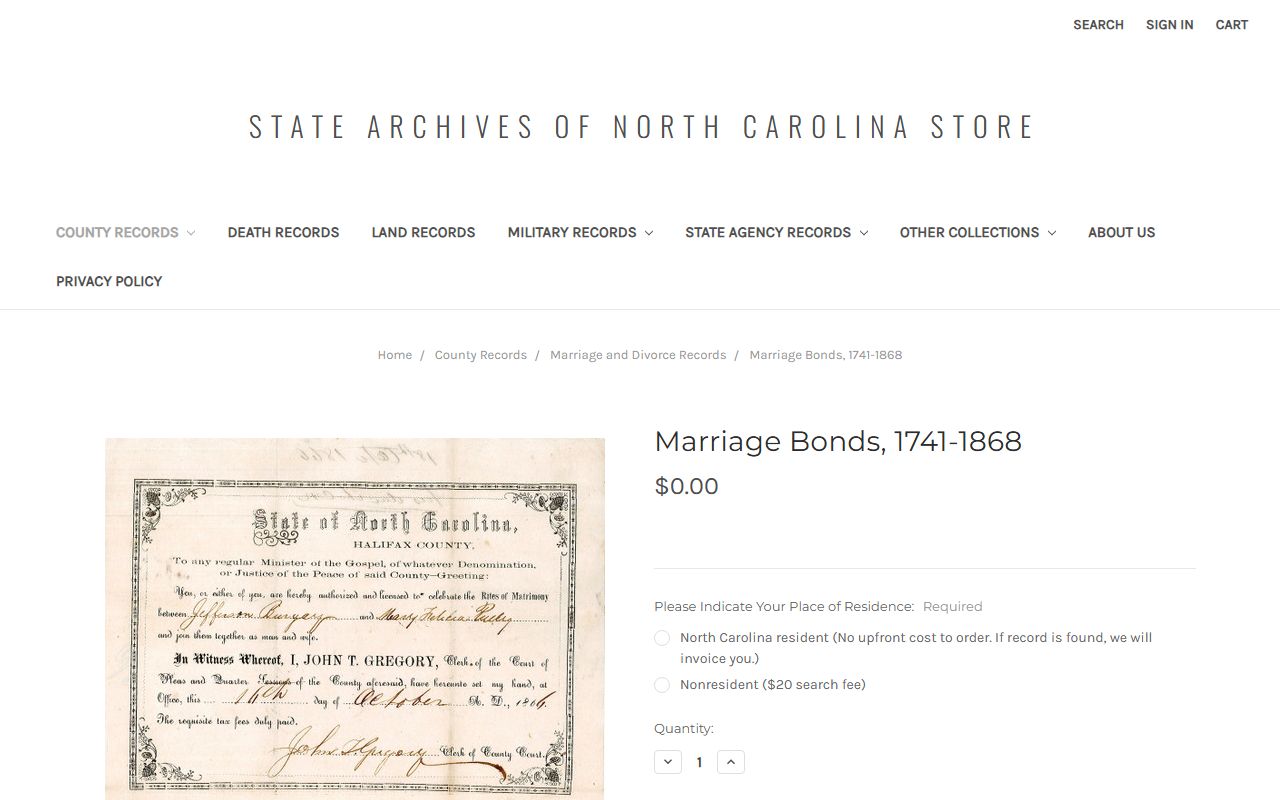
Marriage records in Chatham County begin in 1771. Early marriage bonds survived the courthouse fires in part because they were recorded in bound volumes. Bonds name the groom, the bondsman, and the bond amount. The bondsman was often a brother or father of the bride.
After 1868, marriage licenses replaced bonds. Licenses include both parties' names, ages, birthplaces, and parents' names. The officiant is also named. These records are kept at the Register of Deeds in Pittsboro. Some have been digitized and are available through the DigitalNC collection.
Quaker marriage records provide an additional layer for Chatham County research. The Society of Friends kept careful records of marriages within their meetings. These records predate civil records in some cases and survive in Quaker meeting archives. They name the couple, their parents, and the witnesses who attended the ceremony.
Chatham County Land Records
Land deeds in Chatham County date from 1771. The county sits along the Deep and Haw rivers, and early deeds describe property by these waterways. River bottom land was prized for farming. Upland tracts were used for timber and grazing.
Early land grants in Chatham County came from the colonial government and later from the state. These grants name the recipient, the acreage, and the location by creek or river. Subsequent deeds record how land changed hands through sale, gift, or inheritance. Chain of title research using the grantor and grantee indexes can trace property through multiple generations.
Some deed books survived the courthouse fires. Others were reconstructed from private copies. The Register of Deeds can help you determine which books are originals and which are reconstructions. The North Carolina State Archives holds copies of some early Chatham County land grants that were recorded at the state level.
Chatham County Quaker Genealogy
Quaker families were among the earliest settlers of Chatham County. The Society of Friends established monthly meetings in the area before the county was formally created. These meetings kept birth, marriage, death, and membership records. Quaker records are among the best-kept genealogy sources in North Carolina.
The Cane Creek Meeting, Rocky River Meeting, and other Chatham County Quaker congregations maintained minutes that record family events in detail. When members moved away, removal certificates documented their departure and named the meeting they planned to join. These certificates trace migration patterns across states and decades.
Many Chatham County Quakers migrated to Indiana, Ohio, and other states in the early 1800s. If your Chatham County line seems to vanish, check Quaker meeting records in those states. The Guilford College library in Greensboro holds a large collection of North Carolina Quaker records, and some are available online.
- Monthly meeting minutes with family records
- Birth and death registers kept by each meeting
- Marriage certificates signed by witnesses
- Removal certificates for migrating families
- Disownment records noting discipline actions
Chatham Probate and Estate Records
Probate records in Chatham County begin in 1771. Wills name heirs and distribute property. Some early wills were lost in the courthouse fires, but others survived in recorded volumes or through copies held at the state level. Estate inventories list personal property and its value.
Guardian bonds name orphaned or fatherless children and the adults appointed to care for them. Administrator bonds were filed when someone died without a will. Both record types name family members and their relationships. Estate sales list buyers of personal property. Neighbors and family members often purchased items, creating a record of community ties.
Note: Original probate files are at the Clerk of Superior Court, while recorded wills are at the Register of Deeds in Pittsboro.
Chatham Revolutionary War Records
Chatham County played a role in the American Revolution. Local militia units formed soon after the county was created in 1771. Muster rolls, pay records, and pension applications document Chatham County men who served. The North Carolina State Archives holds many of these records.
Pension applications filed by veterans or their widows are especially rich for genealogy. They include sworn statements describing military service, family details, and places of residence. A widow's pension application often names her husband, their marriage date, and their children. These files are held at the National Archives and are available online through various databases.
Land bounty grants were issued to some Revolutionary War veterans. These grants gave veterans land in exchange for military service. Chatham County veterans may have received grants in the county or in western North Carolina. The state land grant office records at the State Archives track these awards.
Chatham Vital Records and Research
Birth and death records in Chatham County begin in 1913. Before that date, researchers must rely on church records, cemetery inscriptions, and family documents. Chatham County has dozens of old church cemeteries and family burying grounds. Headstone inscriptions provide names, dates, and sometimes family relationships.
Certificates from 1913 forward can be ordered from the Register of Deeds in Pittsboro or from the North Carolina Vital Records office. Visit vitalrecords.nc.gov for ordering details. The Siler City area, once a center of the textile industry, has its own cluster of churches and cemeteries with genealogy value.
Census records for Chatham County are available from 1790 forward. The 1790 census lists heads of household only. The 1850 census names every person. Pair census records with land, probate, and marriage records for a thorough picture of Chatham County families. The DigitalNC project offers additional digitized materials from the county.
Nearby Counties
These counties border Chatham County. Families often crossed county lines for trade, church, and marriage. Check neighboring records when your research reaches a dead end in Chatham.