
Moore County Genealogy Records
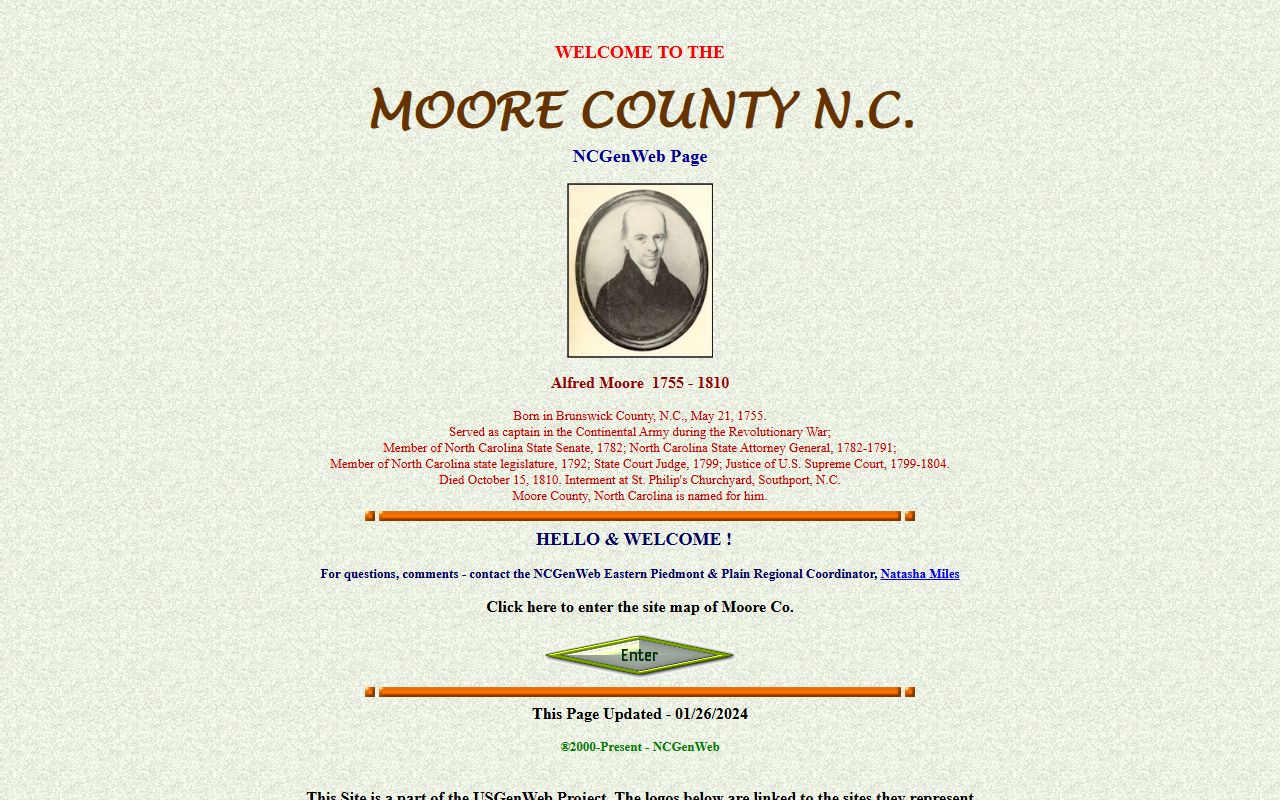
Moore County occupies the Sandhills region of south-central North Carolina, an area defined by its sandy soil, longleaf pine forests, and mild climate. Created in 1885 from Cumberland County, it was named for Alfred Moore, an Associate Justice of the United States Supreme Court. The county seat is Carthage, where the courthouse has served as the center of government since the county's founding. Moore County's genealogy records reveal a history rooted in farming families, turpentine workers, and railroad communities that shaped the Sandhills long before the resort communities of Pinehurst and Southern Pines arrived.
Moore County Quick Facts
Moore County Register of Deeds Office in Carthage
The Moore County Register of Deeds maintains the official genealogy records for the county from its offices in Carthage. Marriage records, land deeds, and court documents date back to 1885, when Moore County began operating as an independent county. Birth and death records are available from 1913, following the statewide vital registration law. Wills recorded between 1885 and 1968 are also held at the courthouse and provide important genealogical evidence for researchers tracing families in the Sandhills region.
The Register of Deeds can be reached at (910) 947-6370 for questions about record availability, copy fees, and office hours. The main courthouse number is (910) 947-6363. Researchers visiting in person will find the courthouse at 102 E Morganton Street in Carthage. The office staff can assist with locating specific records in the deed books, marriage registers, and other indexes. For those unable to visit in person, written requests for copies of specific records can be submitted by mail, though you will need to provide enough identifying information for the staff to locate the correct document.
| Register |
Moore County Register of Deeds 102 E Morganton Street Carthage, NC 28327 Phone: (910) 947-6370 |
|---|---|
| Courthouse |
Moore County Courthouse 102 E Morganton Street Carthage, NC 28327 Phone: (910) 947-6363 |
| Website | moorecountync.gov/rod/ |
Moore County Marriage Licenses and Genealogy Records
Marriage records in Moore County begin in 1885, the year the county was organized. Because the county was formed relatively late compared to many North Carolina counties, researchers tracing families in the Moore County area before 1885 must look to Cumberland County records for marriages that took place in the same geographic region. The transition between Cumberland and Moore County record-keeping is an important consideration for genealogy researchers working across the 1885 boundary.
The marriage licenses recorded in Moore County from 1885 onward provide the names of both parties, the date of the license, and the name of the officiant who performed the ceremony. Later records include additional details such as ages, birthplaces, parents' names (including mothers' maiden names), occupations, and whether either party had been previously married. These details make marriage records one of the most information-rich sources available for genealogy research in Moore County.
The communities of Pinehurst and Southern Pines, which grew rapidly after the arrival of the railroad in the 1890s, attracted residents from across the country. Marriage records for these communities may involve spouses from distant states, reflecting the cosmopolitan nature of the resort towns. In contrast, marriages recorded in rural areas of Moore County, such as the communities around Robbins, Vass, and Cameron, tend to involve families with deeper local roots in the Sandhills.
Land and Property Records in Moore County
Land records at the Moore County Register of Deeds begin in 1885 and document property transactions throughout the Sandhills region. The landscape of Moore County is characterized by sandy, well-drained soils that supported longleaf pine forests and, in earlier times, a thriving naval stores industry producing turpentine, tar, and pitch. Property descriptions in early deeds reference these natural features, along with creeks, old roads, and neighboring landowners that help researchers place families in specific locations within the county.
The development of Pinehurst by James Walker Tufts beginning in 1895 transformed the land records of Moore County. Large tracts of land were purchased for resort development, and the resulting subdivision plats, lot sales, and commercial leases created a distinct category of records. For genealogy researchers, these records can help trace families who were either part of the resort community or who sold their farmland to developers as the resort towns expanded.
For land records before 1885, researchers should consult the Cumberland County deed books, which cover the area that became Moore County. The North Carolina State Archives in Raleigh holds original land grants for the region, documenting the earliest transfers of land from the state to individual settlers. Many of these grants were issued in the late 1700s and early 1800s to families who cleared and farmed the Sandhills for generations before Moore County existed as a separate jurisdiction.
Birth and Death Vital Records in Moore County
Birth and death registration in Moore County follows the statewide pattern, with systematic records beginning in 1913. The North Carolina Vital Records office in Raleigh maintains certified copies of these records and can process requests by mail or in person. For genealogy researchers, birth certificates provide parents' names, birthplaces, and occupations, while death certificates list the cause of death, burial location, and informant, who was typically a family member.
Before 1913, researchers must turn to alternative sources for birth and death information in the Moore County area. Cemetery records are particularly important in this regard. Moore County has dozens of family cemeteries, church graveyards, and community burying grounds scattered across the Sandhills. Many of these have been transcribed by volunteers working with the NCGenWeb Moore County project, and the transcriptions are available online. Older cemeteries associated with Presbyterian, Baptist, and Methodist churches in communities like Carthage, Cameron, and Aberdeen contain graves dating back well before the county's formation.
Obituaries published in local newspapers provide another source of birth and death information for Moore County residents. The Pilot, which has served the Southern Pines and Pinehurst area since the early twentieth century, contains obituaries with biographical details that often go beyond what appears on a death certificate.
Moore County Probate Wills and Estate Records
Wills recorded in Moore County span from 1885 to 1968 and provide direct evidence of family relationships, property ownership, and personal wishes. A will from this period typically names the testator's spouse, children, and sometimes grandchildren or other relatives, along with specific bequests of land, personal property, or money. For genealogy researchers, wills are often the single most informative document for establishing who belonged to a particular family in Moore County.
Estate records held by the Clerk of Superior Court complement the wills and include inventories, accounts of sale, and final settlements. These documents show what a person owned at the time of death and how the estate was divided among heirs. In cases where a person died without a will (intestate), the court appointed an administrator to handle the estate, and the resulting records often name the heirs at law, providing the same type of family information that a will would contain. The turpentine stills, farm equipment, and timber holdings that appear in Moore County estate inventories reflect the agricultural and industrial character of the Sandhills community.
Shaw House and Moore County Historical Association
The Shaw House in Southern Pines is operated by the Moore County Historical Association and serves as a local history museum and research facility. The house itself dates to the 1840s, when it was built by Charles Shaw, a farmer and turpentine producer. The historical association maintains collections of photographs, documents, maps, and family files that are valuable to genealogy researchers studying Moore County families.
The Moore County Historical Association has also published local histories and compiled genealogical data related to the founding families of the county and the surrounding Sandhills region. Their collections include materials on the Scots who settled in the upper Cape Fear region, the African American families who built communities in Moore County after the Civil War, and the northern transplants who came to the area with the development of the resort communities. Researchers planning a visit to the Shaw House should contact the association in advance to arrange access to their research materials.
Beyond the Shaw House, other historical resources for Moore County genealogy include the Southern Pines Library and the Carthage Public Library, both of which maintain local history collections with books, newspapers, and vertical files related to the county's families and communities.
Court and Civil Case Records in Moore County
Court records from Moore County begin in 1885 and include civil suits, criminal proceedings, guardianship appointments, and other legal actions that provide genealogy researchers with names, dates, and family details. Guardianship records identify minor children who needed a legal guardian, typically after the death of one or both parents, and list the guardian's name and relationship to the child. These records are held at the Clerk of Superior Court's office in the Carthage courthouse.
Because Moore County was carved from Cumberland County, researchers investigating court records before 1885 should search the Cumberland County court files. Cases that were pending at the time of the county's creation may have been transferred to the new Moore County court, but earlier resolved cases remained in Cumberland County's files. The North Carolina State Archives holds microfilmed court minutes and loose court papers from both counties that can be reviewed in Raleigh.
Genealogy Research Tips for Moore County Families
Moore County's relatively recent formation in 1885 means that researchers must bridge the gap between county records and the earlier records of Cumberland County. The first step in any Moore County genealogy project should be to determine whether your family was already in the area before 1885 or arrived afterward. Families present before the county's formation will have earlier records under Cumberland County, while those who arrived with the railroad and resort development in the 1890s and beyond may have origins in other states entirely.
Federal census records for the Moore County area before 1890 are found under Cumberland County. The 1890 census was largely destroyed by fire, so the 1880 Cumberland County census and the 1900 Moore County census are the closest available records spanning the county's creation. The 1900 census is particularly useful because it asks for the month and year of birth, the number of years married, and the number of children born and surviving, all of which are valuable for genealogy research in Moore County.
Military records are another important resource. Moore County men served in both World Wars, and their draft registration cards and service records provide biographical details including date of birth, physical description, employer, and next of kin. For the Civil War period, the area was part of Cumberland County, and soldiers from the region can be traced through Confederate and Union service records at the National Archives. The Moore County Historical Association and the NCGenWeb project have compiled some of these military records for easier access by researchers.
Nearby Counties
Moore County is surrounded by several counties in the Sandhills and Piedmont regions. Families living near the borders may have recorded events in neighboring counties. Check the following counties for additional genealogy records related to your Moore County research.