
Bladen County Genealogy Search
Bladen County is known as the "Mother County" of North Carolina because 37 other counties were carved from its original territory. Created in 1734 from New Hanover Precinct, Bladen once stretched from the Cape Fear River to the mountains. The county seat is Elizabethtown. Named for Martin Bladen, a Commissioner of Trade and Plantations, this county offers genealogy records reaching back to the mid-1700s. Three courthouse fires have affected the collection, but many records still survive and reward careful research.
Bladen County Quick Facts
Bladen County Genealogy Office
The Bladen County Register of Deeds operates from the courthouse at 106 W. Broad Street in Elizabethtown. This office holds marriage licenses, land deeds, and other recorded documents. Staff can assist with genealogy searches and provide copies of records on file. The phone number is 910-872-7200.
Marriage records begin in 1748. Land records also start in 1748, along with court and probate files. Earlier records were lost in a 1756 courthouse fire, which destroyed most documents from the county's first two decades. A second fire in 1800 and a third in 1893 caused additional losses. Despite these events, the surviving records span nearly three centuries and are well preserved.
The county's website at bladennc.gov has general information about county offices and services.
| Office |
Bladen County Register of Deeds 106 W. Broad Street Elizabethtown, NC 28337 Phone: (910) 872-7200 |
|---|---|
| Hours | Monday through Friday, 8:00 AM to 5:00 PM |
| Website | bladennc.gov |
Note: Because of the three courthouse fires, researchers should expect gaps in the record chain, especially before 1756.
Bladen County as the Mother County
Understanding Bladen County's role as the "Mother County" is essential for genealogy research. When the county was formed in 1734, it covered a vast area of south-central and western North Carolina. As the population grew, portions were cut off to form new counties. This process continued for over a century.
If your ancestor lived in what is now a different county before that county was created, their records may be in Bladen County. For example, Cumberland County was formed from Bladen in 1754. Anyone living in that area before 1754 would have filed records in Bladen County. The same applies to dozens of other counties that trace back to Bladen.
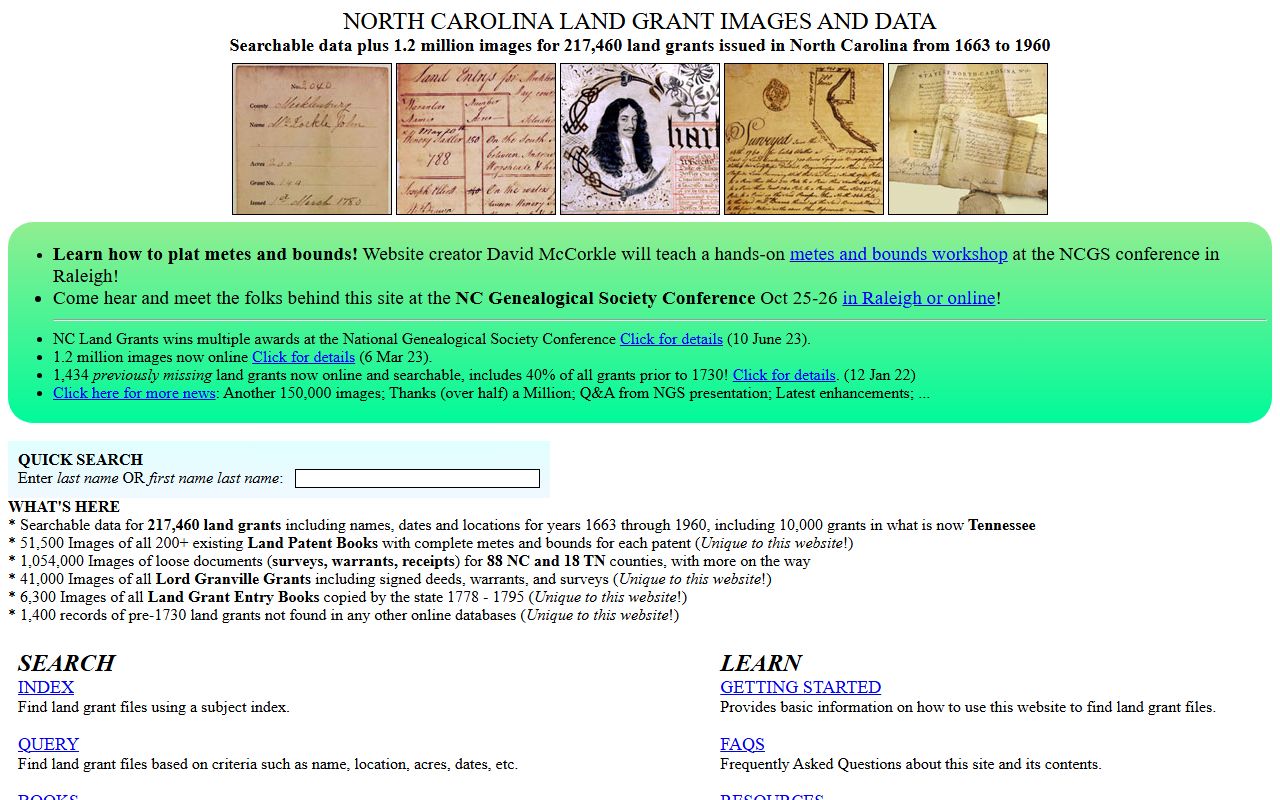
The image below shows North Carolina land grant records, which are particularly relevant for Bladen County genealogy since the county's original territory covered so much of the state.
Researchers should map out the county formation dates to know which records to search. A family that appears to "vanish" from Bladen County may simply have been placed in a newly formed county without moving at all. This is a common source of confusion in North Carolina genealogy, and Bladen County sits at the center of it.
Bladen County Land and Court Records
Land records in Bladen County start in 1748. The Cape Fear River was the main waterway through the county, and early land grants clustered along its banks. Deeds from this period describe property by natural features. They name creeks, swamps, trees, and the owners of neighboring tracts. These neighbor names are valuable for genealogy because they often indicate family or social connections.
Court records also begin in 1734, though the 1756 fire destroyed most of the earliest volumes. The surviving court minutes from the late 1700s forward contain a mix of civil and criminal cases, road orders, tavern licenses, and orphan court proceedings. Orphan court records are especially useful. They name minor children, their deceased parent, and the appointed guardian.
Probate records start in 1748. Wills name family members and distribute property. Estate inventories list personal belongings and their value, painting a picture of daily life. Estate accounts show payments to heirs and creditors. Together, these probate records can fill in an entire family structure for a Bladen County ancestor.
- Deed books from 1748 record land sales and family transfers
- Court minutes from the late 1700s include orphan proceedings
- Wills and estate records name heirs and family members
- Land grants show original settlers along the Cape Fear
Bladen County Vital Genealogy Records
Birth and death registration in Bladen County began in 1913. The state vital records office handles requests for copies of these documents. You can order them through NC Vital Records online or by mail.
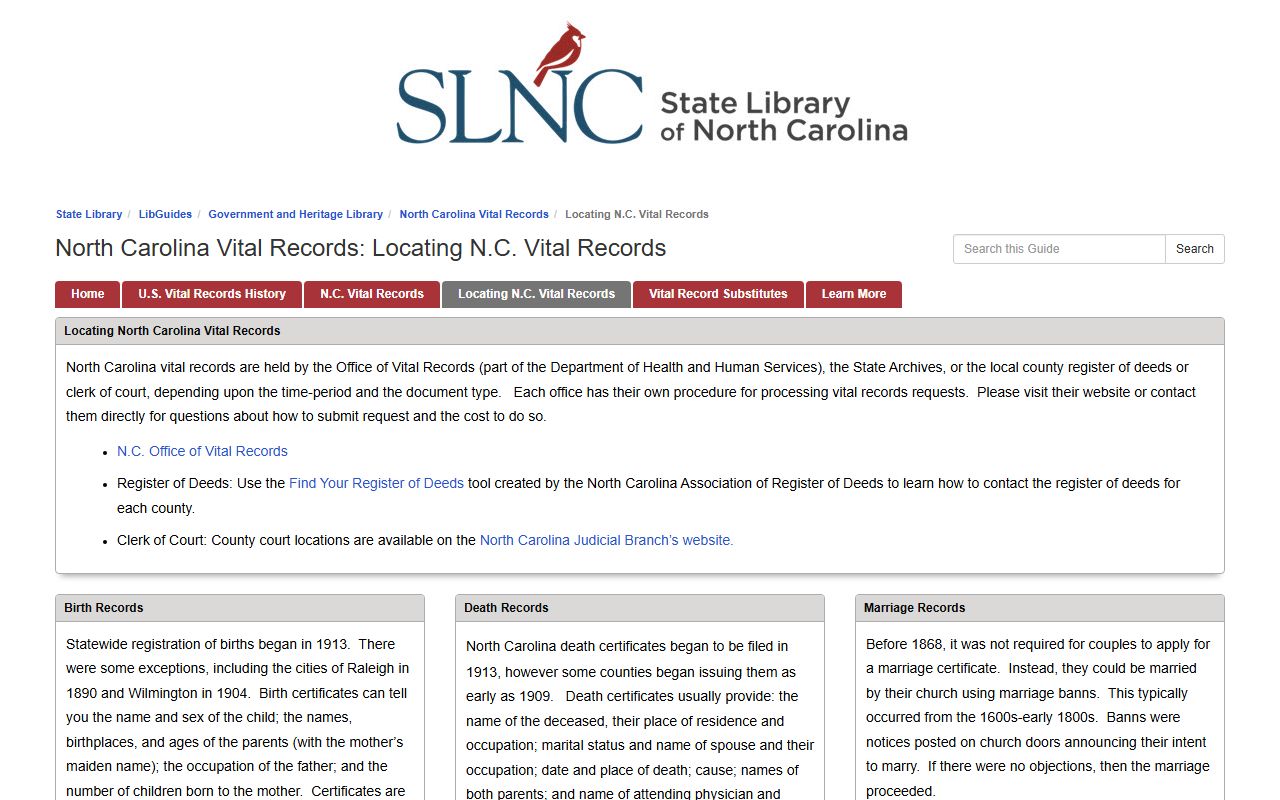
The state vital records resource image below shows information about ordering birth, death, and marriage certificates that cover Bladen County.
Marriage records are the oldest vital records in Bladen County, going back to 1748. Marriage bonds from the 1700s and 1800s are a key genealogy source. Each bond names the groom, the bride, and a bondsman. The bondsman was usually a male relative of the bride, often her father or brother. This third person can break through a genealogy wall when other records do not name the bride's family.
For records before 1913, look to church registers, family bibles, and newspaper notices. Several Baptist and Presbyterian churches in Bladen County kept early registers. The DigitalNC collection includes digitized newspapers from the county that contain obituaries, marriage announcements, and other family information.
Note: Death records from before 1913 may exist in church records or in delayed birth and death certificates filed with the state after 1913.
Researching Bladen County Genealogy
The key to Bladen County research is understanding which records survived the three courthouse fires. The 1756 fire destroyed most records from the first two decades. The 1800 fire caused further losses. The 1893 fire damaged additional volumes. Despite all this, a significant body of records remains, particularly from the late 1700s forward.
Census records help fill the gaps. Federal census records for Bladen County begin with the 1790 count. The 1790 and 1800 censuses list only heads of household but give tallies of household members by age group. From 1850 forward, every person in the household is listed by name, age, birthplace, and occupation. North Carolina also conducted state censuses in 1784 to 1787 that may include Bladen County residents.
Tax records are another way to track families between census years. Bladen County tax lists name property owners and show their land holdings. A man who appears on the tax list one year and disappears the next may have died, moved, or had his land placed in a new county. Cross-checking tax lists with deed books can clarify what happened.
Military records round out the picture. Men from Bladen County served in the Revolutionary War, War of 1812, and Civil War. Pension files and service records at the National Archives and the NC State Archives often include family details such as a wife's name, children, and place of residence.
Bladen County Cemetery Genealogy
Cemeteries across Bladen County hold headstones dating to the late 1700s. Some family cemeteries on private land are harder to reach but contain the earliest inscriptions. Town cemeteries in Elizabethtown and surrounding communities have been surveyed and transcribed by local volunteers.
Headstone data can confirm dates, spousal names, and family groupings that supplement courthouse records. When a courthouse fire has destroyed the original documents, a headstone may be the only surviving record of a person's life dates. The Bladen County Historical Society can provide guidance on locating specific burial sites in the area.
Nearby Counties
These counties adjoin Bladen County. Because Bladen was the parent county for so many others, records for your ancestor may be split between Bladen and one of the counties formed from it. Always check formation dates when researching across county lines.