
Robeson County Genealogy Records
Robeson County was created in 1787 from Bladen County and named for Colonel Thomas Robeson, a Revolutionary War hero. Lumberton, the county seat, sits along the Lumber River and has been the center of county government since the earliest days. Robeson County holds a unique place in North Carolina genealogy as home to the Lumbee tribe, the largest Native American population in the state. Courthouse fires in 1804, 1818, and 1840 destroyed portions of early records, but documents from the mid-1800s onward are generally intact. The cultural diversity of Native American, European, and African American communities creates a genealogical landscape unlike any other.
Robeson County Quick Facts
Robeson County Register of Deeds in Lumberton
The Robeson County Register of Deeds is the primary custodian of vital records, property documents, and marriage licenses in the county. Birth and death registration in Robeson County began in 1913 when the state of North Carolina mandated the recording of these events. Marriage records date to 1787, the year the county was formed, though the courthouse fires of 1804, 1818, and 1840 destroyed many of the earliest marriage bonds and licenses. Records from the mid-1800s forward have survived intact.
Land records and deeds in Robeson County also date to 1787, with the same caveat about fire losses affecting the earliest volumes. The surviving land records document property ownership and transfers along the Lumber River, Raft Swamp, and throughout the agricultural lowlands of southeastern North Carolina. For genealogists, these property records can reveal family relationships, economic standing, and patterns of settlement across generations. The Register of Deeds office is located at 500 N. Elm Street in Lumberton and is open to the public during regular business hours.
| Office |
Robeson County Register of Deeds 500 N. Elm Street Lumberton, NC 28358 Phone: (910) 272-5900 |
|---|---|
| Courthouse |
Robeson County Courthouse 500 N. Elm Street Lumberton, NC 28358 Phone: (910) 272-5900 |
| Website | co.robeson.nc.us/departments/register-of-deeds |
Robeson County Marriage Records from 1787
Marriage records in Robeson County officially begin in 1787, but the courthouse fires of 1804, 1818, and 1840 destroyed many of the earliest bonds and licenses. The records that survive from the pre-fire period are fragmentary, and researchers working on early Robeson County marriages may need to consult Bladen County records, church registers, and family documents to fill in the gaps. From the mid-1800s onward, the marriage record collection in Robeson County is substantially complete.
The marriage records of Robeson County reflect the county's diverse population. Researchers may find records documenting marriages within the Lumbee community, European settler families, and African American families, each with distinct naming patterns and community connections. Marriage bonds from the early decades of the county often name a bondsman who was a relative of the bride, providing clues about her family that might not be available from any other source.
Later marriage licenses include the full names of both parties, their ages, places of residence, and the names of their parents. Certified copies of marriage records can be obtained from the Register of Deeds office in Lumberton. For marriages after 1962, the statewide index at the North Carolina Vital Records office can help locate records when the county of marriage is uncertain.
Lumbee Tribe and Native American Genealogy in Robeson County
Robeson County has the largest Native American population of any county in North Carolina, centered on the Lumbee tribe. The Lumbee people have lived in the swamplands and river bottoms of Robeson County and the surrounding area for centuries. Tracing Lumbee ancestry presents unique challenges because the community has historically been classified under different racial categories in government records. Census enumerations, court records, and vital records may identify Lumbee individuals variously as "Indian," "mulatto," "free colored," or other terms depending on the era and the individual census taker.
Despite these classification challenges, substantial documentation exists for Lumbee families. The Robeson County court records contain petitions, land transactions, and legal proceedings involving Lumbee individuals from the early 1800s onward. Church records, particularly from Baptist congregations in the county, document baptisms, marriages, and deaths within the community. The Robeson County History Museum has assembled research materials specifically focused on Lumbee family history, and the museum staff can assist researchers navigating these specialized records.

Court Records and Estate Files in Robeson County
Court records in Robeson County date to 1787, though the three courthouse fires significantly reduced the earliest volumes. The surviving court records from the mid-1800s through the present cover civil disputes, criminal cases, estate settlements, guardianship matters, and a wide range of other legal proceedings. Estate records are particularly valuable for genealogists because they name family members and describe the distribution of property after a person's death.
Will records in Robeson County provide detailed information about family relationships. A typical will names a spouse, children, and sometimes grandchildren or nieces and nephews. The testator describes real estate, personal property, and any specific bequests. Estate inventories taken after death list every item of value owned by the deceased, while sale records show who purchased items at the estate auction. These sale records frequently name neighbors and relatives who attended the sale in Robeson County.
The Clerk of Superior Court in Lumberton maintains the court and estate records and can assist researchers with locating specific files. The Robeson County History Museum has also compiled indexes and finding aids that can direct researchers to the most relevant records for their family lines.
Birth and Death Records in Robeson County
Official birth and death registration in Robeson County began in 1913 along with the rest of the state. For events before that year, researchers must seek out alternative documentation. Church records from Baptist, Methodist, and Presbyterian congregations in Robeson County recorded baptisms, burials, and membership information that can substitute for missing vital records. Cemetery surveys conducted by local historical societies document headstone inscriptions throughout the county and provide dates that may not be recorded elsewhere.
Delayed birth certificates filed in the 1930s and 1940s can be found at the Register of Deeds office. These registrations were typically filed by individuals born before 1913 who needed proof of age. The supporting documentation often includes affidavits from older relatives or community members that contain genealogical information about the person's parents and place of birth. For certified copies of birth and death certificates from 1913 forward, contact the North Carolina Vital Records office in Raleigh. Birth records are restricted for 100 years, and death records are restricted for 25 years.
Robeson County Land and Property Records
Land records in Robeson County date to 1787, though the earliest volumes were affected by the courthouse fires. Surviving land records from the mid-1800s onward document property ownership throughout the county's extensive territory. Robeson County is one of the largest counties in North Carolina by area, and its land records cover a wide geographic range from the Lumber River bottomlands to the higher ground of the Sandhills.
Property deeds in Robeson County frequently identify family relationships. Deeds of gift between parents and children confirm direct lineage. Partition deeds among heirs reveal siblings and their spouses. The grantor and grantee indexes maintained by the Register of Deeds office in Lumberton allow researchers to trace property ownership by surname. For the Lumbee community, land records are particularly important because they document property ownership and family connections that census records of the period may not adequately capture.
Robeson County Historical Background for Genealogy Research
Robeson County was carved from Bladen County in 1787. Researchers tracing families before that date must consult Bladen County records, and before 1734 when Bladen was formed, the relevant records fall under New Hanover County. This chain of parent counties is important for following family lines backward through the colonial period. The county's location in southeastern North Carolina placed it along trade routes connecting the Cape Fear region to the interior of the state.
The three courthouse fires of 1804, 1818, and 1840 represent the single greatest obstacle for Robeson County genealogists. Each fire destroyed varying amounts of records, leaving gaps in the documentation from the county's first fifty years. However, some records survived because they were in private hands, recorded in other counties, or preserved in state-level archives. The North Carolina State Archives in Raleigh holds some early Robeson County documents that were copied or transferred before the fires occurred.
The agricultural economy of Robeson County was built on naval stores, tobacco, and cotton. Turpentine production from the longleaf pine forests was a major industry during the 1800s, and the records of these enterprises appear in court filings, tax lists, and property transactions at the courthouse. The arrival of the railroad in the mid-1800s transformed Lumberton into a commercial hub and attracted new residents whose families can be traced through the county's later records.
Robeson County Genealogy Research Resources
The Robeson County History Museum in Lumberton is a key resource for genealogists researching families in the county. The museum holds documents, photographs, and family files that complement the official records at the courthouse. Their collection includes materials specifically related to Lumbee family history, making it an essential stop for researchers tracing Native American ancestry in the region.
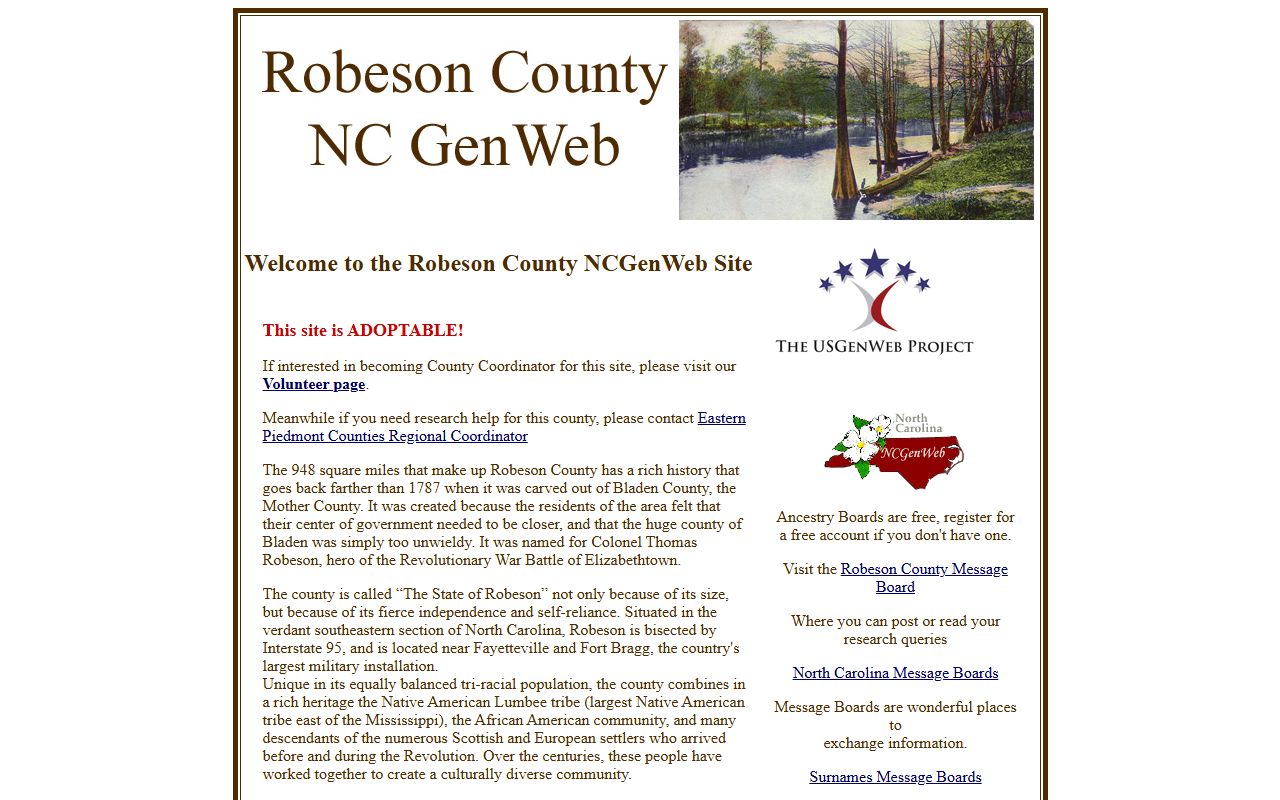
The NCGenWeb Robeson County page provides free online access to transcribed records, cemetery surveys, and a message board for connecting with other researchers. Volunteers have transcribed portions of the county's surviving records, including census data, marriage records, and tax lists. FamilySearch.org has digitized some Robeson County records and made them available for free online viewing.
The North Carolina State Archives in Raleigh holds microfilm copies of many Robeson County records, including surviving deed books, court minutes, and vital records. For researchers working on Lumbee genealogy, the University of North Carolina at Pembroke maintains special collections related to the Lumbee people and the history of Robeson County. The North Carolina Vital Records office handles requests for certified copies of birth, death, and marriage certificates from 1913 forward.
Counties Neighboring Robeson County
Robeson County shares borders with several counties in southeastern North Carolina, and families in this region moved freely across county lines for trade, marriage, and land. Checking records in neighboring counties can uncover additional documentation about your Robeson County ancestors.