
Nash County Genealogy Records
Nash County lies in the inner Coastal Plain of northeastern North Carolina, a fertile agricultural region where families have cultivated tobacco, cotton, and corn for over two centuries. Established in 1777 from Edgecombe County, it was named for Brigadier General Francis Nash, mortally wounded at the Battle of Germantown. The county seat is Nashville, which has hosted county government since its earliest days. Nash County's genealogy records span from the late colonial period to the present and include marriage bonds, land grants, court proceedings, wills, and vital records documenting the families who settled along the Tar River.
Nash County Quick Facts
Nash County Register of Deeds in Nashville
The Nash County Register of Deeds in Nashville is the official keeper of vital records and property documents for the county. Marriage records date back to 1777, the year of the county's formation, and represent one of the oldest continuous record series in eastern North Carolina. Land records and court documents also begin at that date. Birth and death records start in 1913 under the statewide vital registration mandate, and wills recorded between 1777 and 1968 are available at the courthouse. These wills are among the most genealogically valuable records in the county because they frequently name spouses, children, and other family members.
The Register of Deeds office can be contacted by phone at (252) 459-9836 for questions about specific records, fees, and hours of operation. The Nash County Courthouse is located at 120 W Washington Street in Nashville, with a general phone number of (252) 459-4000. Researchers planning a visit should call ahead to confirm that the records they need are available for public viewing, as some older volumes may be fragile or undergoing preservation work. The staff is experienced in helping genealogy researchers navigate the county's historical record books and indexes.
| Register |
Nash County Register of Deeds 120 W Washington Street Nashville, NC 27856 Phone: (252) 459-9836 |
|---|---|
| Courthouse |
Nash County Courthouse 120 W Washington Street Nashville, NC 27856 Phone: (252) 459-4000 |
| Website | nashcountync.gov/rod/ |
Nash County Marriage Bonds and License Records
Marriage records from Nash County beginning in 1777 are among the earliest available in this region of North Carolina. The first records take the form of marriage bonds, which required the groom or a close associate to post a financial guarantee that no legal barrier to the marriage existed. The bond document typically names the groom, the bride, and the bondsman, who was frequently the bride's father, brother, or another male relative. This makes marriage bonds a primary tool for identifying family relationships in Nash County during the late 1700s and early 1800s.
As the system evolved over the nineteenth century, marriage licenses replaced bonds and began including more information. By the late 1800s, Nash County marriage licenses recorded the full names of both parties, their ages, residences, parents' names, and the name of the person performing the ceremony. Ministers from Baptist, Methodist, and other congregations in Nash County frequently officiated, and their names on the licenses can help researchers connect families to specific church communities. Justices of the peace also performed many marriages, particularly in the more rural parts of the county.
The twentieth-century marriage records in Nash County are the most detailed, containing birthplaces, occupations, number of previous marriages, and full parental information including mothers' maiden names. These records are especially useful for tracking families during the period of significant population movement as the tobacco economy drew workers to the region and the city of Rocky Mount grew into a major commercial center straddling the Nash and Edgecombe county line.
Nash County Land Deeds and Property Grants
Land records in Nash County extend back to 1777 and document property ownership across a landscape of fertile bottomlands along the Tar River and Stony Creek, as well as higher ground suited to tobacco and cotton cultivation. Early deeds and land grants describe parcels using the metes and bounds system, referencing natural features like creeks, marked trees, and neighboring property owners. These descriptions can help genealogy researchers pinpoint exactly where an ancestor lived and farmed in Nash County.
The grantor and grantee indexes at the Register of Deeds office provide the entry point for searching land records. By tracing all purchases and sales by a particular surname, researchers can follow a family's movement within Nash County and identify transactions between relatives that suggest family connections. It was common for parents to sell or gift land to children, and these transfers are documented in the deed books. Likewise, divisions of inherited land among heirs after a death can reveal the names and numbers of children in a family.
Original land grants for the Nash County area, issued by the colonial government and later by the state of North Carolina, are preserved at the North Carolina State Archives in Raleigh. These grants predate the county's deed records in some cases and document the first distribution of land to settlers who moved into the Tar River valley during the colonial period. Researchers working on the earliest Nash County families should examine both the state grant records and the county deed books for a complete picture of land ownership.
Birth and Death Registration in Nash County
North Carolina's statewide birth and death registration law took effect in 1913, and Nash County records from that date forward are maintained by both the county and the North Carolina Vital Records office in Raleigh. Birth certificates recorded in Nash County provide the child's name, date and place of birth, parents' names, parents' birthplaces, and the father's occupation. Death certificates include the decedent's name, date and place of death, cause of death, burial location, and the name of the informant, who was usually a family member or attending physician.
For births and deaths before 1913, researchers must rely on alternative sources. Cemetery records throughout Nash County preserve names and dates that predate the vital registration system. Church records from the many Baptist and Methodist congregations in the county contain entries for baptisms, burials, and membership rolls that help establish birth and death dates. Family Bible records, where families inscribed births, marriages, and deaths on the pages between the Old and New Testaments, are another important source that has been partially compiled by the NCGenWeb Nash County project.
Nash County Wills and Probate Estate Settlements
The will books of Nash County cover the period from 1777 to 1968 and represent a foundational resource for genealogy research. Wills from the late colonial and early federal periods in Nash County often reflect the agricultural economy of the time, with bequests of land, livestock, farming implements, and enslaved persons. These documents name family members and establish relationships that might not appear in any other record type. For researchers studying Nash County families during the eighteenth and nineteenth centuries, wills are indispensable.
The probate process in Nash County also generated estate inventories, accounts of sale, and guardianship bonds that add detail to the picture provided by wills. Inventories list every item of personal property owned by the deceased, from plows and horses to beds and cooking utensils, offering a glimpse into daily life. Accounts of sale record who purchased these items, often naming neighbors and relatives. Guardianship bonds identify minor children who needed a legal guardian and the person appointed to care for them, frequently an older sibling, uncle, or family friend.
Researchers should note that some Nash County estates were settled without a will, in which case the Clerk of Superior Court appointed an administrator. The administrator's records, including bonds, inventories, and final accounts, serve a similar function to will records and can be found in the estate files at the courthouse in Nashville.
Braswell Memorial Library North Carolina Room
The Braswell Memorial Library in Rocky Mount houses the North Carolina Room, a special collections area dedicated to local and regional history. This room contains books, microfilm, newspapers, photographs, and vertical files related to Nash County and the surrounding area. For genealogy researchers, the North Carolina Room provides access to resources that may not be available elsewhere, including compiled family histories, local newspaper indexes, and records that supplement the official courthouse documents.
The library's collection includes microfilmed census records, city directories for Rocky Mount, and back issues of local newspapers that contain obituaries, wedding announcements, and other notices of genealogical value. The staff in the North Carolina Room are familiar with the types of questions genealogy researchers typically have and can help guide visitors to the most relevant materials. Rocky Mount straddles the Nash and Edgecombe county line, so the library's collections cover both counties and are useful for researchers whose families lived in either jurisdiction.
Nash County Historical Association and Local Heritage
The Nash County Historical Association works to preserve and share the history of the county and its communities. The association has published historical accounts, collected photographs and documents, and organized events that bring together people with an interest in Nash County's past. For genealogy researchers, the association can serve as a connection to local knowledge and resources that may not be available through official records or online databases.
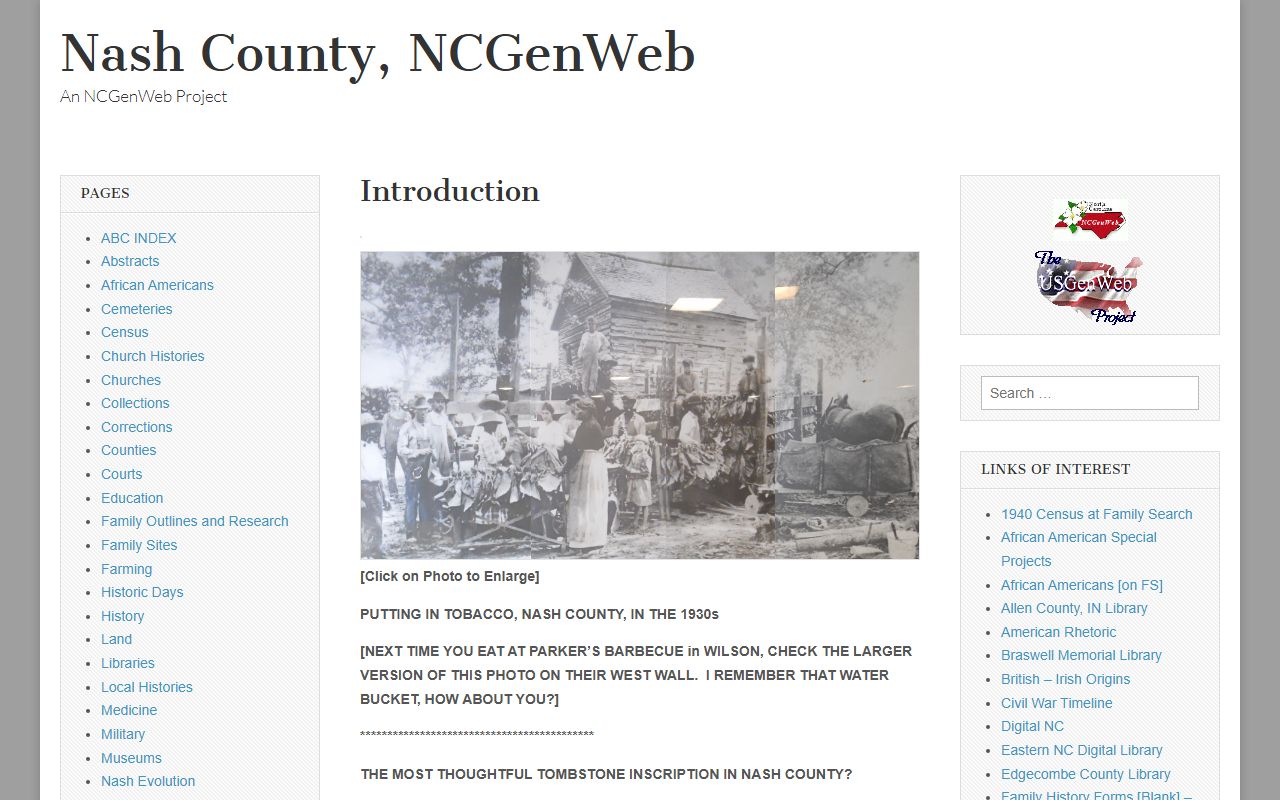
Nash County's history is deeply connected to the agricultural economy of eastern North Carolina. Tobacco farming dominated the county's economy for much of the nineteenth and twentieth centuries, and the warehouses and markets in Rocky Mount and Nashville were centers of commercial activity. The railroad, which arrived in the mid-1800s, transformed Rocky Mount into a transportation hub and brought new residents to the area. These economic and demographic changes are reflected in the county's genealogy records, from land transactions and business partnerships to the growth of church congregations and civic organizations.
African American genealogy research in Nash County benefits from records held at the courthouse, the Braswell Memorial Library, and the Freedmen's Bureau records at the National Archives. After the Civil War, formerly enslaved people in Nash County established their own churches, schools, and communities. Records from this period, including marriage registrations, land purchases, and school enrollment documents, help trace African American families in Nash County from emancipation forward.
Genealogy Research Approaches for Nash County
Researchers beginning a genealogy project in Nash County should identify the relevant time period and locate the correct set of records. For families present before 1777, Edgecombe County records are the primary source, as that is the parent county from which Nash was formed. After 1777, the Nash County courthouse in Nashville holds the main records. Researchers should also be aware that portions of Nash County were later taken to form other counties, so boundary changes may affect where records are filed.
Federal census records for Nash County begin with the 1790 census, which lists only heads of household with counts of other household members by age and sex. The 1850 census is the first to name every individual in each household and is a critical starting point for mid-nineteenth-century research. Slave schedules from 1850 and 1860 list slaveholders and the number, ages, and sexes of enslaved persons, which are important for African American genealogy research even though they do not typically name the enslaved individuals.
Tax lists, militia rolls, and voter registrations from Nash County provide supplemental information that helps place individuals in the county at specific times. These records are held at the North Carolina State Archives in Raleigh and have been partially indexed and microfilmed. Combining these administrative records with the deed books, marriage records, and will books at the courthouse gives researchers the most complete picture of Nash County families across generations.
Nearby Counties
Nash County shares borders with several other counties in the inner Coastal Plain. Families near the county boundaries may appear in the records of adjacent counties, particularly along the shared Nash-Edgecombe line that runs through the city of Rocky Mount. Consider searching the following counties for related genealogy records.