
Graham County Mountain Genealogy
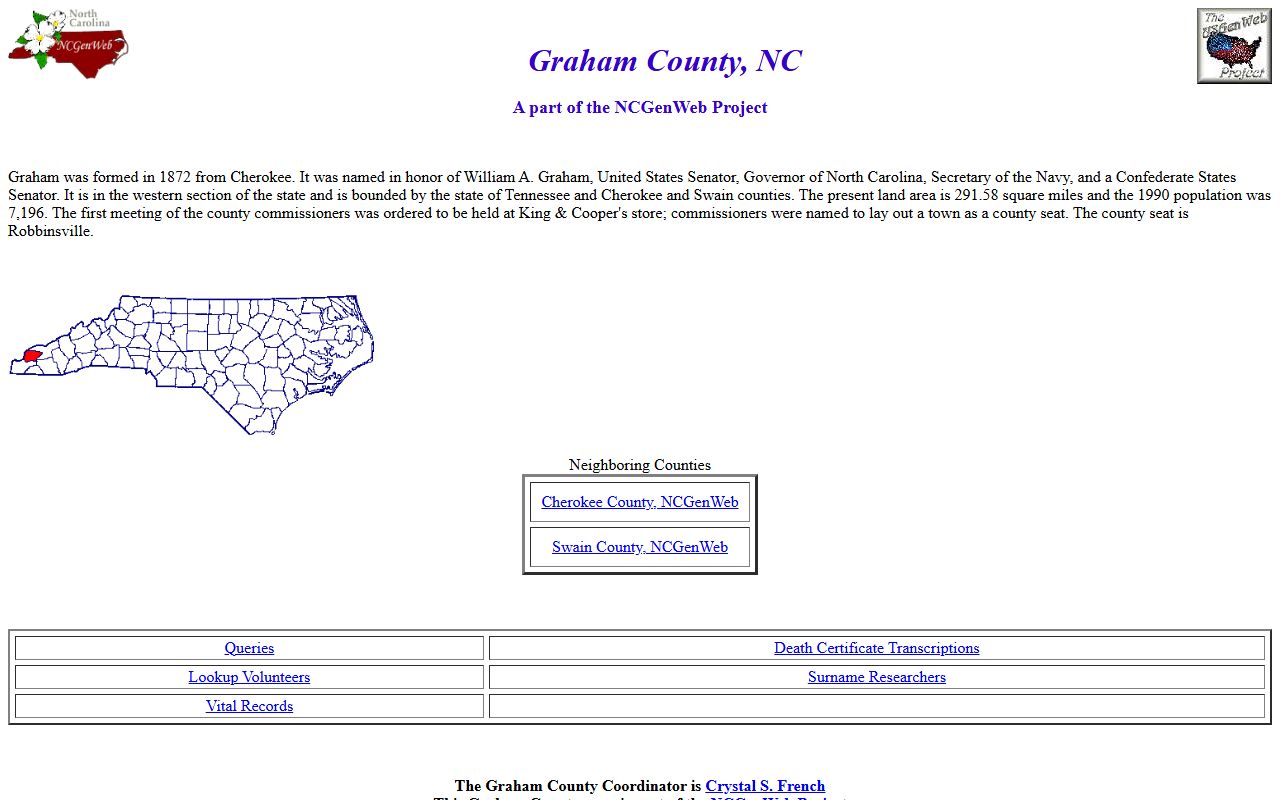
Graham County was created in 1872 from Cherokee County and named for William Alexander Graham, who served as a North Carolina senator, governor, and U.S. Secretary of the Navy. The county seat is Robbinsville. Graham County is the westernmost county in North Carolina, bordered by Tennessee to the north and west. Portions of the Cherokee Indian Reservation lie within its boundaries. Genealogy records begin in 1872, though some older records transferred from Cherokee County cover earlier years. The mountain terrain and remote setting shaped both the settlement patterns and the records that survive.
Graham County Quick Facts
Graham County Register of Deeds
The Graham County Register of Deeds is located at 12 North Main Street in Robbinsville. This office holds marriage records from 1873, land records from 1873, and birth and death certificates from 1913. The staff can assist with searches and provide copies of records on file.
Graham County is one of the least populated counties in North Carolina. The small size of the population means that many families are interconnected, and a single visit to the Register of Deeds can yield records touching on multiple branches of a family tree. The office maintains deed books, marriage registers, and vital records indexes that cover the full history of the county from its founding to the present day.

| Office |
Graham County Register of Deeds 12 North Main St. Robbinsville, NC 28771 Phone: (828) 479-7971 |
|---|---|
| Website | grahamcounty.org/departments/register-of-deeds |
Graham County Vital Records
Birth records in Graham County officially begin in 1913, when statewide registration started. However, delayed birth certificates from the late 1800s also exist. These were filed later in life by individuals who needed proof of birth for Social Security, passports, or other purposes. Delayed certificates often include affidavits from family members or neighbors who could attest to the date and place of birth. They are a unique genealogy resource in Graham County.
Death records start in 1913 as well. Birth records from 1913 to 1990 and death records from 1913 to 1991 are available through FamilySearch. Marriage registers covering 1873 to 1970 can also be accessed through that platform. These digitized records allow researchers to search from home, which is especially useful given the remote location of Graham County in the western mountains.
For certified copies of vital records, contact the Register of Deeds in Robbinsville or the North Carolina Vital Records office in Raleigh. The state office handles requests for birth and death certificates statewide.
Note: Delayed birth certificates in Graham County may contain errors in dates or spellings. Cross-reference them with census records and family sources when possible.
Graham County Land Records
Land records in Graham County begin in 1873. The mountainous terrain meant that land parcels were often irregular in shape and described by natural features such as ridgelines, creek beds, and rock outcroppings. These descriptions can be difficult to interpret without knowledge of local geography, but they place families in specific locations within the county.
The federal government retained large tracts of land in western North Carolina that later became part of the Nantahala National Forest. Land grants and entries from the state of North Carolina document the transfer of public land to private owners in the 1800s. Some families in Graham County homesteaded land that their descendants still own. Deed records at the Register of Deeds trace this chain of ownership from the original grant to the present. For land records before 1872, researchers should check Cherokee County, the parent county of Graham.
Cherokee Heritage Records
Graham County includes portions of the Qualla Boundary, which is the principal land base of the Eastern Band of Cherokee Indians. Genealogy research involving Cherokee families requires specialized sources beyond the standard county records. The Baker Roll of 1924 and the earlier Churchill Roll of 1908 list members of the Eastern Band and are key documents for tribal genealogy.
Federal census rolls for the Eastern Cherokee were taken separately from the regular U.S. census. These special enumerations list tribal members by name, age, and family group. The National Archives holds many of these records. Researchers with Cherokee ancestry in Graham County should consult both the tribal records and the standard county records, as individuals may appear in both sets of documents depending on the time period and their status within the community.
Court and Probate Records
Court records in Graham County start in 1872. Probate records begin in the same year. These records are held by the Clerk of Superior Court in Robbinsville. Wills, estate inventories, and guardianship files name family members and describe property holdings. In a rural mountain county like Graham, probate records often mention land, livestock, and farming tools that made up the bulk of a family's wealth.
The NCGenWeb Graham County page offers links to transcriptions and research guides for the county. Volunteers have contributed cemetery surveys, family histories, and other materials that supplement the official records at the courthouse.
- Wills and estate files from 1872 at the Clerk of Superior Court
- Marriage registers from 1873 at the Register of Deeds
- Delayed birth certificates from the late 1800s
- Cherokee tribal rolls at the National Archives
- Census records from 1880 onward for Graham County
Research Tips for Graham County
Graham County was carved from Cherokee County in 1872. All records before that date are in Cherokee County. The first federal census that lists Graham County separately is the 1880 census. Earlier census records for the area are found under Cherokee County.
Mountain families in Graham County often stayed in the same area for generations. This stability means that land records and cemetery inscriptions can fill gaps left by missing vital records. Church records from Baptist and Methodist congregations in the mountains also document births, marriages, and deaths that predate the state registration system. Because Graham County borders Tennessee, researchers should also check records in Monroe County, Tennessee, for families who crossed the state line.
Nearby Counties
These counties adjoin Graham County. Cherokee County is the parent county, and its records contain pre-1872 genealogy information for families in the Graham County area.