
Jones County Genealogy Records
Jones County was created in 1778 from Craven County during the heat of the American Revolution. The county seat is Trenton, a small town on the Trent River in the coastal plain of eastern North Carolina. Named for Willie Jones, a bold leader in the fight for independence who pushed for a strong bill of rights, the county has always been one of the smallest in the state by population. Despite its size, Jones County holds land and probate records from 1779 and court files from 1807. Researchers working in this area will find a tight-knit community where family names appear again and again across the records.
Jones County Quick Facts
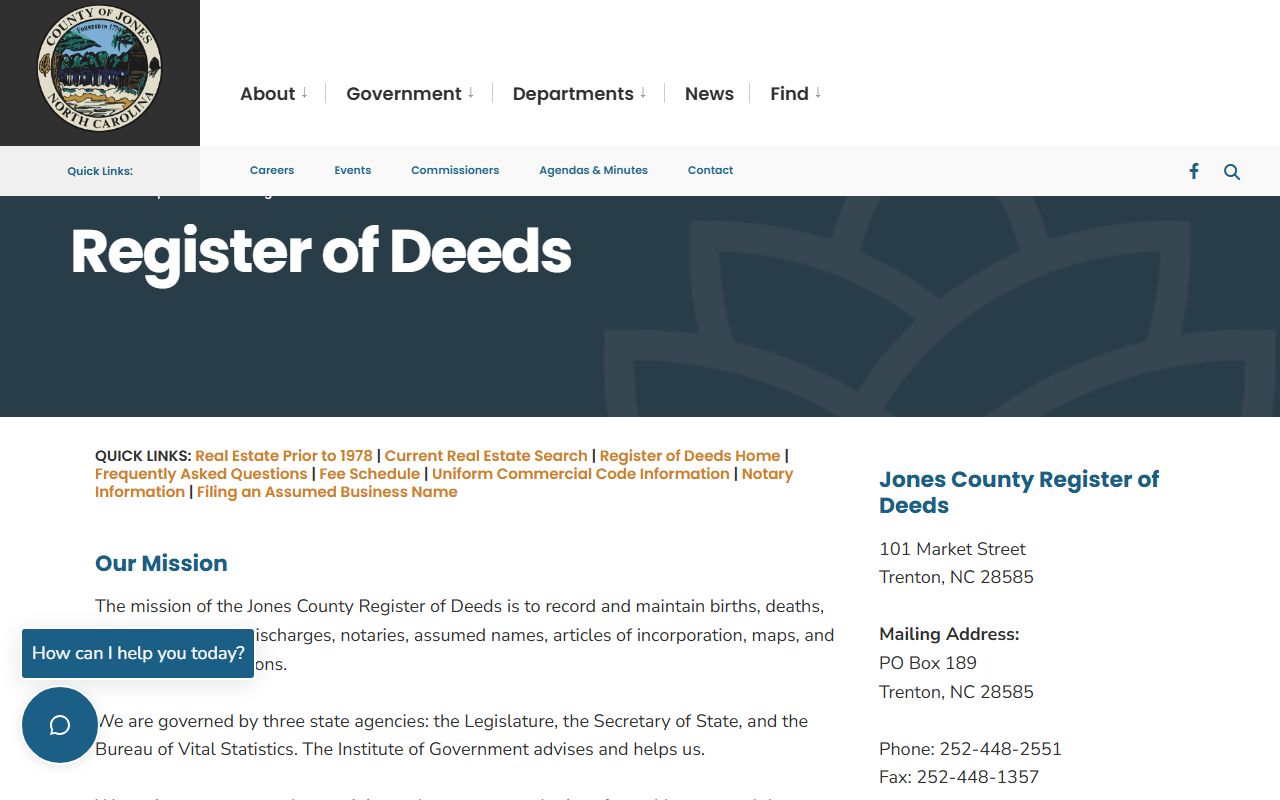
Jones County Register of Deeds Office
The Jones County Register of Deeds in Trenton is the primary office for land transfers, marriage licenses, and vital record copies. Land records start in 1779, just one year after the county was formed, and run without a break to the present day. These deed books trace how coastal plain farms and timber tracts changed hands over the centuries. Marriage records begin in 1850, which means there is a gap of more than 70 years at the start of the county where marriage bonds have not survived or were never filed locally.
Birth and death records are on file from 1913 forward, consistent with the statewide mandate that took effect that year. The Register of Deeds also maintains military discharge records for veterans who chose to file their papers with the county. These discharge records can include the name, rank, dates of service, and unit of a veteran, which is useful for linking a person to pension files and military service records at the state and federal level.
| Office |
Jones County Register of Deeds PO Box 189 Trenton, NC 28585 Phone: (252) 447-2551 |
|---|---|
| Hours | Monday through Friday, 8:30 AM to 5:00 PM |
| Website | jonescountync.gov/register-of-deeds |
Craven County Records for Jones Research
Since Jones County was carved from Craven County in 1778, all records for the area prior to that date are held in Craven County, with the county seat in New Bern. Craven is one of the original precincts of the colony and has records stretching back to the early 1700s. If your Jones County family has roots that go deeper than 1778, Craven County deed books, court minutes, and estate files are the next place to look. New Bern was the colonial capital, and many of the oldest records in eastern North Carolina are tied to Craven.
Tax lists from the 1770s in Craven County can help you identify families that were living in the part of the county that would soon become Jones. These lists name heads of household and note their taxable property, which gives you a snapshot of who was there just before the split. Craven County also has early church records, particularly from the Anglican (later Episcopal) parish that served the area. These parish registers may list baptisms, marriages, and burials that predate any courthouse record in Jones County.
Jones County Land Grants and Probate Files
Land records are the backbone of genealogy research in Jones County. The deed books from 1779 show how tracts along the Trent River and White Oak River were bought, sold, and passed down through families. Many of the early grants in this part of North Carolina were for large acreage, and the grantees often subdivided and sold off portions to newcomers. Following the chain of title for a single tract can reveal multiple generations of a family and their connections to neighbors who later became in-laws.
Probate records from 1779 include wills, administrations, inventories, and estate sales. A will from the late 1700s in Jones County might name a wife, several children, and the specific tracts of land each child was to receive. Inventories list every item of value owned by the deceased, from farm tools and livestock to kitchen goods and books. Estate sales name the buyers and the prices paid, and these buyers are often sons, sons-in-law, or brothers of the deceased. The patterns of who bought what at an estate sale can confirm family relationships that no other record spells out.
Note: Some early Jones County probate files are fragile. The Clerk of Superior Court may not allow direct handling of the oldest papers. Microfilm copies, where they exist, are the preferred way to access these records.
Court Minutes and Civil Records in Jones County
Court records in Jones County begin in 1807, which leaves a gap from the county's 1778 formation. Some of the earlier court proceedings may have been lost or may never have been kept in a bound volume. The court minutes that do survive from 1807 forward are held at the Clerk of Superior Court in Trenton. These minutes cover civil suits, criminal cases, road orders, and appointments of guardians and administrators. For genealogy, the civil and estate-related entries are the most useful because they name parties, describe property, and spell out family relationships.
Guardianship records from the court can be especially valuable in Jones County. When a parent died and left minor children, the court would appoint a guardian to manage the children's share of the estate. The guardian was required to file periodic accounts showing how the money was spent. These accounts name the children and sometimes note when a child married or came of age, which gives you dates and connections that are hard to find anywhere else. Apprenticeship bonds, filed when a child was bound out to learn a trade, are another court record that names children, their parents, and the master to whom they were bound.
Jones County Marriage Records from 1850
Marriage records in Jones County start in 1850 and are held at the Register of Deeds. The absence of marriage bonds before 1850 is a real challenge for researchers tracing families in the late 1700s and early 1800s. For those earlier years, you will need to rely on other sources to infer marriage connections. Wills that name a son-in-law, deeds that transfer land to a daughter and her husband, and court records that list a woman by her married and maiden name can all serve as evidence of a marriage that was never recorded in a bond book.
From 1850 forward, the marriage records in Jones County grow steadily more detailed. By the late 1800s, marriage certificates list the full names of the couple, their ages, birthplaces, the names of both sets of parents, and the name of the minister or justice who performed the ceremony. These records are among the best single sources in genealogy because they link two families in one document. The NCGenWeb Jones County page has some volunteer transcriptions of marriage records that you can search at no cost.
Birth and Death Records for Jones County
Statewide registration of births and deaths began in North Carolina in 1913, and Jones County records follow this pattern. For events before 1913, you will need to turn to church records, cemetery transcriptions, family Bibles, and newspaper notices. Churches in Jones County include Baptist, Methodist, and Disciples of Christ congregations, many of which kept registers of baptisms and burials that go back well before 1913. These church records are scattered across local churches, the North Carolina State Archives, and private hands.
Cemetery records are another critical source in Jones County. Many of the oldest graves sit in family plots on private land or in church yards along back roads. Local volunteers have walked these cemeteries and written down the names and dates from the headstones. Some of these transcriptions are posted on the NCGenWeb Jones County page, and others are held in manuscript form at the state archives or local libraries. A headstone can give you a death date, a birth date, and sometimes a maiden name or a note about military service that you will not find in any courthouse file.
For certified copies of birth or death certificates from 1913 to the present, contact the Jones County Register of Deeds in Trenton or the North Carolina Vital Records office in Raleigh.
Genealogy Challenges in Small Rural Counties
Jones County is one of the least populated counties in North Carolina, and that small size creates both benefits and problems for genealogy research. On the plus side, a small population means fewer people to sort through when you are looking for a specific name. The same families tend to show up again and again in the records, and you can often trace several generations without leaving the county. On the down side, some records were not kept as carefully as in larger counties, and losses over the years have left gaps that are hard to fill.
The lack of a local newspaper for much of the county's history means that obituaries and social notices are thin before the 1900s. Neighboring county papers, such as those in New Bern (Craven County) and Kinston (Lenoir County), sometimes covered events in Jones County and are worth checking. The small number of churches also means fewer church records, but the ones that do exist tend to cover a large share of the population because there were few choices for where to worship in rural Jones County.
Nearby Counties
These counties border Jones County. Families in this part of eastern North Carolina often had ties across county lines, especially along the Trent and Neuse rivers. Check neighboring counties if your family appears in Jones County records and then seems to vanish.